Financial institutions today operate in an environment that is constantly changing. Customer expectations are higher than ever, regulations evolve frequently, and markets demand speed without compromising trust or security.
To meet these demands, many financial organizations are rethinking how their technology systems are designed and managed. The objective is not simply to adopt new technology, but to build systems that are more flexible, resilient, and closely aligned with business needs.
In the financial sector, system reliability and stability are critical. Even a small disruption can impact customer confidence, regulatory compliance, and financial performance. At the same time, organizations must be able to adapt quickly—whether to introduce new products, respond to market changes, or comply with evolving regulations.
To address these challenges, financial institutions are exploring modern approaches to system design that support both stability and change. One such approach that has gained significant attention across industry is microservices architecture.
What is Microservices Architecture?
At a high level, microservices architecture is an approach to building systems by dividing them into smaller, focused components. Each component is responsible for a specific business function and can be developed, updated, or improved independently of others.
Instead of managing one large, complex system, organizations manage a collection of smaller parts that work together to deliver business capabilities. This approach helps financial institutions reduce complexity, improve system resilience, and make changes more safely and efficiently.

Unsplash Picture
Why Microservices Matter for Financial Institutions
Microservices architecture supports financial organizations in managing complexity while maintaining stability, security and control. Its value lies not in technology alone, but in how it enables better business outcomes.
1. Faster response to change
Financial regulations, market conditions, and customer expectations change frequently. Microservices allow organizations to update specific business functions without impacting the entire system, reducing the risk and effort involved in change.
2. Improved system resilience
By separating systems into smaller parts, issues in one area are less likely to disrupt others. This helps maintain continuity of critical financial services and reduces the impact of failures.
3. Scalability to meet growing demand
Financial systems must handle varying levels of activity, such as peak transaction periods or business growth. Microservices make it easier to scale individual business functions as needed, ensuring consistent performance without overloading the entire system.
4. Stronger security and risk control
By separating systems into focused components, access and controls can be more tightly managed. This approach helps limit the impact of security incidents and supports compliance by making it easier to monitor, manage, and protect sensitive financial data.
5. Better alignment with business functions
Microservices can be organized around business capabilities such as payments, customer onboarding, or reporting. This makes systems easier to understand, manage, and evolve in line with business priorities.
Microservices Explained with Financial Examples
Think of a bank as a collection of different services: customer accounts, payments, reporting, and onboarding. In traditional systems, all these services are tightly connected, changing one area often affects everything else, which can be slow and risky.
With a microservices approach, each service works independently, like separate teams focused on a single task:
- The payments team can update or scale the payments system for peak hours without disrupting accounts or reporting.
- The reporting team can make regulatory updates without affecting customers making transactions.
- The onboarding team can improve the customer signup process without slowing down payments or account management.
In short, microservices allow each part of the bank to move faster, scale safely, and stay stable, while still working together to deliver a smooth experience for customers.
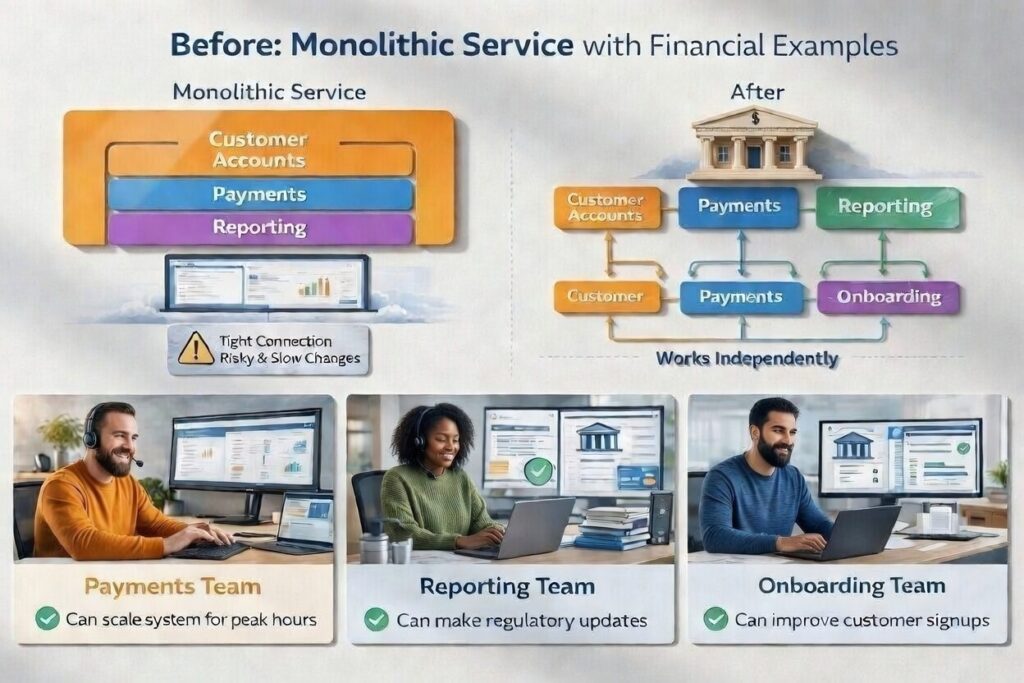 Generated with AI
Conclusion
Microservices architecture is not just a technical shift, but a strategic approach to building financial systems that can evolve safely and sustainably. By aligning technology more closely with business functions, financial organizations are better positioned to manage change, scale with confidence, and maintain the trust of customers and regulators.
References:
Microservices Architecture in Financial Systems